Day 6 - morning - Todoque
Last but not least – Visit to a Lava Field and Lava Tunnels at Todoque formed during the 1949 eruption of Llano del Banco.
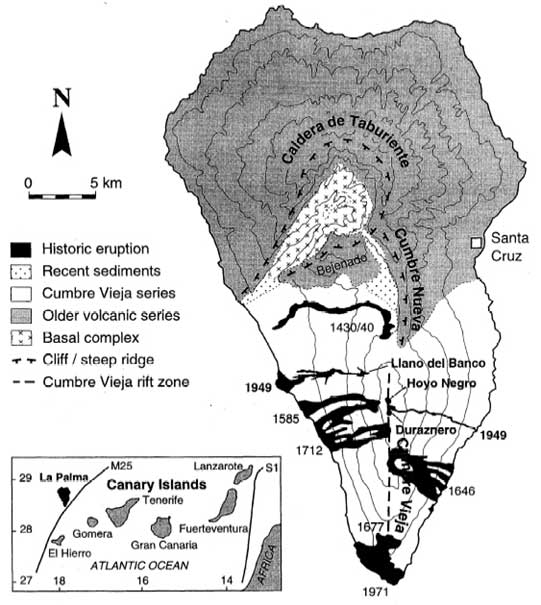
Map of La Palma showing paths of 1949 lava flow
The path of the lava flow is clearly visible on the high, steep slopes and is approximately 60 metres wide at that point. It follows the easiest route down and spreads over a much wider area on the lower slopes; the lava is up to 24 metres deep in places.
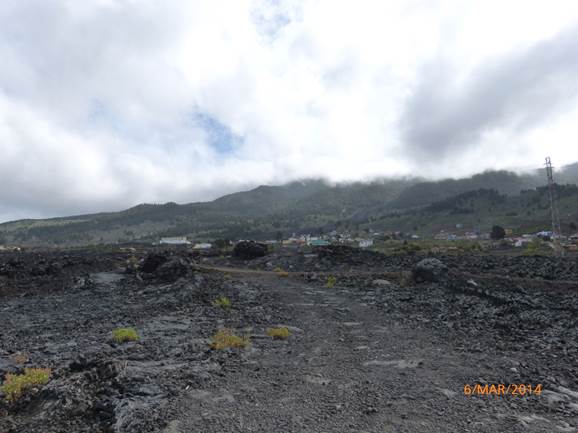
Distant path of lava flow and lava boulders
The eruption took place over a six week period, but no-one was killed and only one person was seriously affected by the poisonous gases. As with all major events, there are local ‘stories’ and it is said that some people gathered at a cross in the village: the lava ran one side of the cross and they were saved. The lava only affected one house – it ran in through the backdoor and out through the front windows! The lava eventually ran over the cliffs, cooled on impact with the seawater and formed a wide shelf of ‘new land’. The original cliffs are now fossilised sea cliffs some way inland.
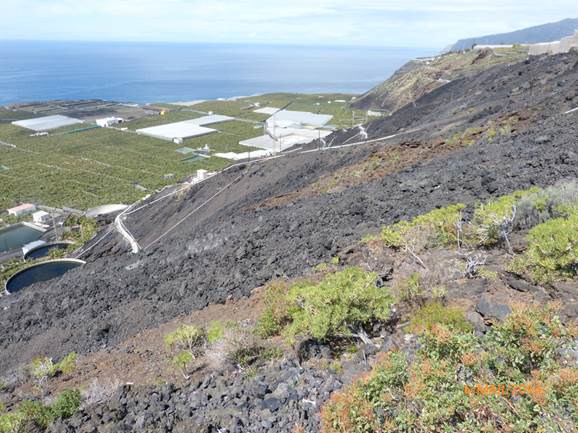
Fossilised cliff with banana plantations on the ‘new land’
We walked over the lava field with our official guide, who pointed out the differing forms of lava, which depends on its viscosity – cooler lava forms a crust as it rolls forward, whereas the hotter and more fluid lava cools forming a very thin, smooth or ‘ropey’ surface with bubbles beneath. This was particularly evident at the collapsed entrance of one lava tunnel where several layers of lava could be seen, which would have been deposited at different times during the eruption.

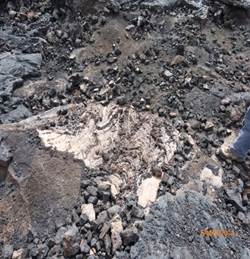
Collapsed roof of lava tunnel Different layers of lava
The tunnels were formed by the very hot viscous lava – the outer edges cool and a crust forms, leaving the lava to run through the middle until the eruption ceases. We also saw several examples of lava boulders - these start as sticky balls of lava that pick up other debris as they roll down the slopes, just like snowballs.
We then donned hard hats and torches and climbed into a lava tunnel. The entrance was exposed due to the roof of the tunnel having collapsed, which meant that it was quite steep and very uneven under foot.
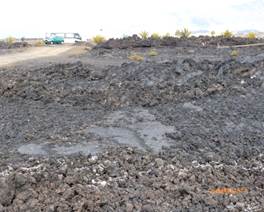
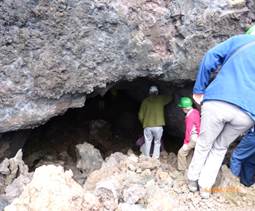
Example of smooth lava Entering lava tunnel
The tunnel diameter varied between 2-5 metres and the average year-round temperature is 19o +/- 2oC. Lighter coloured areas on the roof were explained as being salt, which rain has washed through and there were also ‘drips’ of lava hanging down. It was at this stage that some members of the group thought it prudent to return to the surface, as they were not comfortable to venture further in these difficult conditions. The floor of the tunnel was covered in loose lava and at first the sides and roof were quite rough to touch
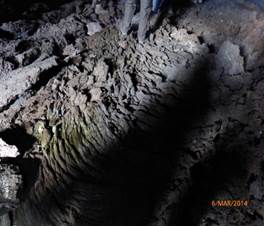
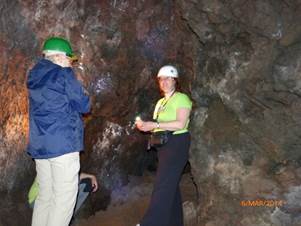
Ropey lava on tunnel floor Sheila, our translator
The guide explained that the tunnel surface can be much smoother and this was evident as we walked in further: hot lava can melt the tunnel lining, which then cools into a smoother surface, sometimes with nodules forming. We also saw another smaller tunnel that joined our tunnel and the guide pointed out the underlying soil that could be observed at this junction.
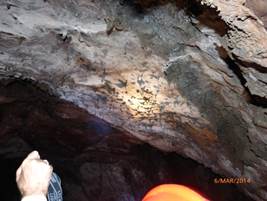
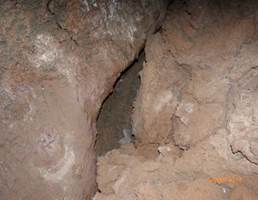
Smooth lava surface with nodules Underlying soil beneath the lava
There were also two instances of lava ‘waterfalls’ on the floor of the tunnel where the path of the lava had been dammed and it had cascaded over.
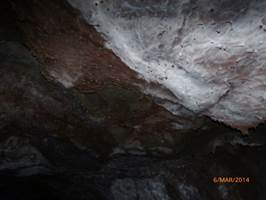
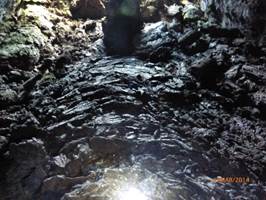
More nodules and calcium carbonate deposit. Lava ‘waterfall’.
Whilst exiting to the surface, the guide informed us that there was a smaller tunnel, approximately 2-3 feet in diameter, above the tunnel we entered, but the roof had collapsed making exploration difficult. This often occurs when the bottom tunnel cools and a new flow of lava runs over the top.
Even after 60+ years there is still little vegetation over large areas of the lava field. Some lichens can be seen, but as this is also the dryer side of the island no soil has been washed down by rainfall to encourage plant growth. However, the ‘new land’ formed by the lava falling into the sea is almost entirely covered by banana plantations. This has been achieved by depositing up to a metre of leaf mould, collected from the forested areas of the island, onto the lava and installing irrigation systems. Banana production is the largest industry on the island.
New properties are evident across the lava field and our guide explained that local people do not appear to worry about foundations. Although a lava tunnel was discovered under one building site they carried on with construction, but left a ladder down into the tunnel!
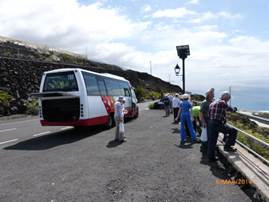
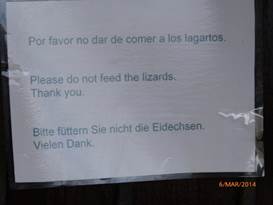
Lunch stop But not for the lizards!
Phil Uncles